



Kristjan Zemljič
Nobody really wants to read your EU proposal.
I don’t mean that as an insult. I mean it structurally. An evaluator sitting down with your Horizon Europe submission has read dozens of proposals that week. They already know what you’re going to say — because 95% of applicants say the same things in the same order with the same vocabulary. No amount of EU proposal writing tips will fix that if the advice itself is generic.
And if you relied on AI for the drafting? They definitely know what you’re going to say.
The Vanilla Problem
Let me test this. Look at your last EU funding proposal and check how many of these apply:
You said “revolutionize.” You used “innovative” and “transformative” in the first two pages. You claimed to be “first on the market.” You described a “novel approach.” You stated no IP is needed. You projected 2% market share. Your methodology section reads: research, design, pilot, collect feedback, improve.
I bet at least four of those landed.
This is what I call vanilla writing. It’s not wrong — it’s invisible. Every word is technically accurate and strategically meaningless. An evaluator reads it and retains nothing, because it sounds identical to the last twelve proposals they scored.
The tragedy is that underneath the vanilla language, most of these projects are genuinely interesting. Real researchers with real ideas, buried under a layer of interchangeable proposal-speak.
AI Made It Worse, Not Better
Here’s the painful and one of my best EU proposal writing tips that most AI training providers won’t tell you: generative AI is the greatest vanilla machine ever built.
ChatGPT doesn’t produce bad writing. It produces average writing — fluent, confident, structurally sound prose that says almost nothing specific. It’s trained on the average of everything, so it produces the average of everything. Ask it to write an impact section and you’ll get “paradigm shift,” “systemic transformation,” and “stakeholder engagement” in the first paragraph.
I’ve spent over 3,100 hours implementing AI into EU proposal processes. The pattern is clear: teams that use AI without underlying methodology get their proposals written faster. They don’t get them funded more. Speed without precision is just faster failure.
The solution isn’t to stop using AI. It’s to use it after you’ve done the strategic work that makes your proposal different. And a big part of that strategic work is language. (We train teams to do exactly this — but here’s the core of it.)
The Emotional Precision Framework
Proposals are persuasive documents read by tired humans under time pressure. An evaluator reading their 15th proposal of the day needs text that does two jobs simultaneously: convey information and make them want to keep reading. Default AI prose only does the first job.
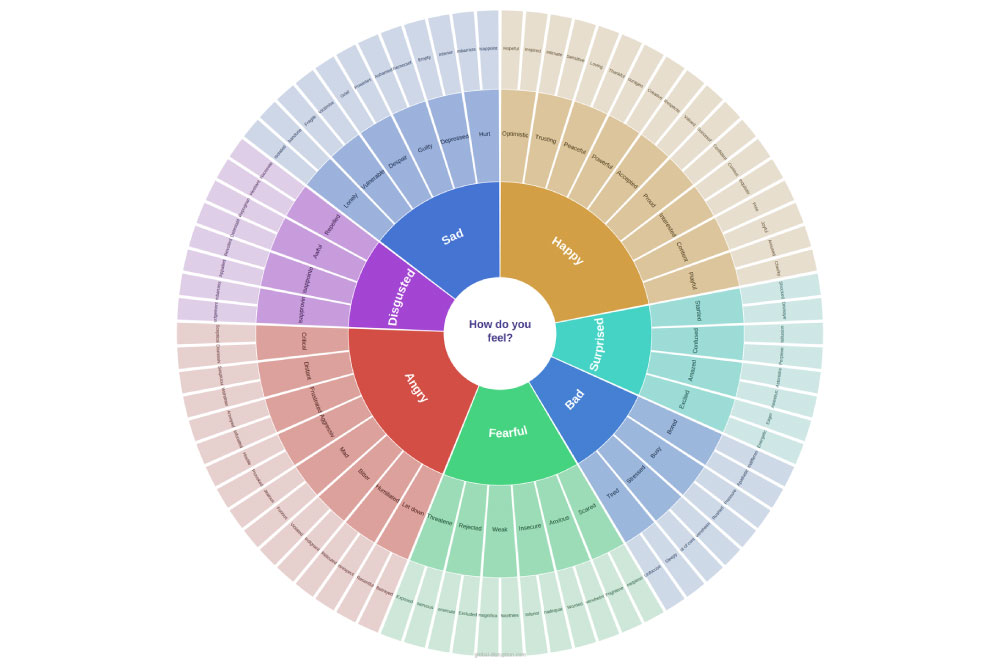
There’s a tool for this, and it comes from psychology, not grant writing. It’s called Plutchik’s Wheel of Emotions — a circular matrix that maps the full spectrum of human emotion. At the centre: basic feelings like joy, trust, fear, and surprise. At the edges: nuanced expressions like optimism, remorse, contempt, and aggressiveness.
Most proposal writers operate in about 5% of this emotional spectrum. They use “important,” “significant,” “challenging,” and “promising.” That’s it. Four words, repeated across 45 pages.
Now imagine a proposal that uses “alarming” instead of “challenging.” Or “overlooked” instead of “under-researched.” Or “courageous” instead of “ambitious.” The information is the same. The emotional resonance is completely different. The evaluator remembers it.
This isn’t about being dramatic. It’s about being precise. “Challenging” is vague. “Alarming” has a direction — it tells the evaluator this problem is urgent, that inaction has consequences. That’s not decoration. That’s communication.
Before and After: De-Vanilla’d Proposal Language
Let me show you what this looks like on a real example.
Vanilla version (what AI generates):
“The increasing prevalence of antimicrobial resistance poses a significant challenge to public health systems across Europe, requiring innovative and collaborative approaches to address this growing concern.”
Every single word in that sentence could appear in any of fifty different proposals. An evaluator’s eyes glaze over by “significant challenge.”
De-vanilla’d version:
“Antimicrobial resistance is not a future threat — it is killing 35,000 Europeans every year right now. Current responses are fragmented, underfunded, and dangerously slow. This project confronts that failure directly.”
Same information. Completely different emotional register. “Killing” instead of “poses a challenge.” “Dangerously slow” instead of “requiring innovative approaches.” “Confronts that failure” instead of “address this growing concern.”
The second version isn’t less academic. It’s more honest. And an evaluator who has read eleven proposals that morning about “significant challenges” will stop and pay attention when someone writes “killing 35,000 Europeans every year.”
Another example — impact section:
Vanilla: “The project will contribute to the digital transformation of European SMEs by providing innovative tools and training methodologies.”
De-vanilla’d: “420,000 European SMEs still operate without a single AI tool. Not because they don’t want to — because nobody built something they could actually use. We did.”
The second version makes a specific, verifiable claim (420,000 SMEs), names the actual problem (usability, not awareness), and positions the consortium’s contribution with confidence. It’s also shorter.
Practical EU Proposal Writing Tips (Without Overthinking It)
You don’t need to rewrite your entire proposal. The emotional precision strategy works best in three places:
The opening of each major section. The first two sentences of Excellence, Impact, and Implementation set the evaluator’s expectation for everything that follows. Make them vivid.
Problem statements. This is where vanilla does the most damage. If your problem description sounds generic, the evaluator assumes your solution is generic too — even if it isn’t.
The project title and abstract. These are the first things evaluators read and the last things most teams write. A memorable title does more work than a perfectly formatted Gantt chart.
Here’s a practical exercise: take any paragraph from your proposal and ask yourself — could this sentence appear in a competing proposal without changing a single word? If yes, it’s vanilla. Rewrite it until it couldn’t.
And yes, you can use AI for this — but in the right direction. Don’t ask AI to write your proposal. Write it yourself first, then upload it with Plutchik’s Wheel and ask AI to identify where your language is emotionally flat. Then rewrite those sentences yourself. Your voice, your judgment, AI as a diagnostic tool — not a replacement.
Why This Matters More Than You Think
I’ve been in EU funding since 2003. I’ve reviewed hundreds of proposals. I’ve trained over 2,700 grant professionals across 130+ institutions. The pattern is consistent: proposals don’t fail because they lack quality. They fail because evaluators can’t tell them apart.
Structural quality matters — compliance, logic maps, evaluator alignment, budget architecture. That’s the engineering layer, and it’s what we spend most of our time building. But even a perfectly engineered proposal needs language that lands. You can have impeccable structure and still score 3.5 on Excellence because the evaluator couldn’t stay awake through your problem statement.
Emotional precision is the last mile. Most people never think about it. The ones who do stand out.
If your team is preparing a multi-partnership EU proposal (e.g. Horizon Europe or Erasmus+ proposal and you want structural depth — not just faster drafting — we can help. Our Grant Engineering system combines senior EU expertise, a proprietary AI engine, and experienced AI operation to produce proposals that reward evaluators for reading. Reach out with your deadline and programme: kristjan@global-disruption.com
P.S. If your proposal opens with “innovative and collaborative,” you already know what to do.